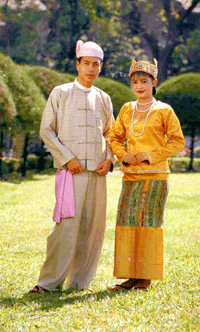
Myanmar
Traditions & Beliefs
03
Traditions are signatures of the country that we live in and which can tell you most of everything about a country. A long and rich traditional life runs through Myanmar’s long and rich history, with Buddhist architecture and incredible creativity. Plus, Myanmar has eight major national ethnic races with some 135 ethnic groups with eight major national races called Kachin, Kayin, Kayah, Chin, Mon, Bamar, Rakhine, and Shan. Although we are living in the same country, we differ in beliefs, beauty standards, and traditions. Thus, if you are studying more about Myanmar’s traditions, we’ve picked out some of the weirdest and wonderful traditions.
1. Kachin ( Animal sacrificing )
Kachin, tribal peoples occupying parts of northeastern Myanmar (Burma). They are famous for their unique traditions and their charismatic minds. The Kachin’s belief form animistic ancestor cult entailing animal sacrifice. They believe that sacrificing animals can bring lucky days to their life. They have been keeping that tradition from their animistic ancestors. Also, they keep buffaloes’ horns to protect their entire house from danger. But today’s Kachin people just use those as their interior decoration.
2. Kayah ( Wearing brass coins )
The Karenni, also known as the Kayah in Burmese. They live in eastern Myanmar. It is on the border with Shan State. The Kayan People The most stunning representation of the culture of the Kayan people are the brass coils worn by their women around their necks. Often known as the long-necked women, they take pride in wearing these brass coils. Traditionally, girls are made to wear these brass coils from the age of five. It is their unique beauty standard that is totally different from ours.
3. Kayin (Deity worship )
Kayin, an ethnic group who inhabit southern Myanmar and have boarded with Mon state. In Kayin state most of the people are Buddhist. As they are Buddhist Kayin people, they believe in Budda But some are animistic believers. In Kayin state, there are two deities most commonly believed to be Pha Htee and A moe which people believe as protectors of Kayin State. People used to make wishes to them and have to promise that they will come back and donate something for them if the wishes come true. It is really famous among Kayin people. However, there is something that you need to be careful about. That’s if you break the promise even though if the wishes come true, you will have to face lots of problems and dangerous accidents.


4. Chin (Tattoo on the women’s faces)
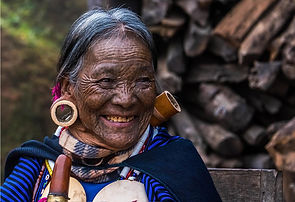
Chin are those who live in Chin State in western Myanmar. They are popular because of their innocent minds. But most people notice their weirdness which totally differs from the other ethnic races. And that’s the only thing that catches people’s attention internationally. It is tattooed chin ladies’ faces. There’s a brief history of why they tattooed their faces. According to local lore, girls in this part of Burma were so beautiful that they were often kidnapped by the kings of neighbouring areas and forced into marriage. In an effort to stop the kidnappings, the Chin elders decided to tattoo the faces of their young girls in order to neutralize their inherent beauty.
5. Burmese (Thanaka )
Burmese people are known as “Bamar” in Myanmar. Burmese people live in the majority of places in Myanmar. But especially in Yangon, Mandalay, Naypyidaw, Magway, Sagaing, Tanintharyi, and Ayeyarwady which are the biggest regions in Myanmar. And there’s a cute traditional beauty standard that most Myanmar people think is graceful. That is “Thanaka (သနပ်ခါး)” that you can see pale yellow paste smeared over Myanmar women’s and kids’ faces. Burmese people believe applying Thanaka improves the complexion, protects skin from the effects of the sun, prevents wrinkles, and is generally a cure-all. And we have been keeping this tradition not to disappear from our lives.

6. Mon (Ship alms donating ceremony)
The Mon are an ethnic group who inhabit Lower Myanmar. The vast majority of Mon are Theravada Buddhists and much of the Mon tradition is influenced by Buddhism. And one of the rarest traditions that we can find among Mon people is the “ Ship alms donating ceremony ”. This ceremony is a religious festival celebrated by the Mon people every year on the full moon day of Thaw Tha Lin. The place where the alms will be placed is shaped like a ship and they come and offer flowers, alms, fruits, and lights at dawn. Plus, there was a story about why the Mon people started this tradition. This tradition began during the reign of King Dhammazedi. During that time, 44 pure Mon monks were sent to Thihaul (Sri Lanka) in two vehicles, Ramaduta and Sitaduta, for the maintenance of the Dharma and lost. Thus, Mon people were shaped In the same way as the missing Sittaduta ship, at dawn on the full moon day of the Thaw Tha Lin and donated alms with various food items and prayed for the ship to be saved. After doing so, it returned safely to the port of Sittaduta on the 2nd day of Tawthalin. Since that time, the Mon people continued doing that donation ceremony till now.
7. Rakhine ( Different wedding tradition)
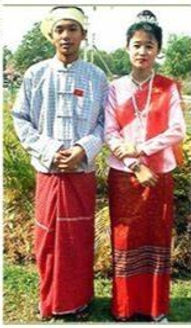
The Rakhine people or Arakanese people are those who live in the coastal area of western Myanmar. Most Rakhine traditions are similar to Burmese traditions but there’s a tradition that is opposite to Burmese’s. It is their wedding. The Rakhine people have preserved their traditions, and the traditional Rakhine wedding ceremony is still celebrated in their traditional ways so far. The Rakhine people call it a "son-in-law ceremony" after a traditional Rakhine wedding because the son-in-law lives in the same house with his mother-in-law. Choosing a bride and groom to marry; Procrastination is also a tradition. In Rakhine youth, parents often choose their spouses when they are young. The groom's parents choose the daughter-in-law and negotiate with the daughter's parents. The engagement ceremony is held at the daughter's parents' house and the two astrologers from the groom’s side have to match their fortune and if their fortune is fine, the groom’s parents have to pay a fee and negotiate. Then, they choose the best day for the wedding and after the wedding, the son-in-law has to live in the mother-in-law’s house which is opposite the Burmese.

8. Shan (The offering of Thanakha incense)
Shan people are those who live in eastern Myanmar. And ninety percent of people are Buddisim so their traditions are also related to Budda. In Shan State, there is the traditional offering of the Thanakha incense lamp, also known as the Tampu Festival, which is one of the traditional Shan rituals and is an annual religious festival of the Shan people. The incense festival is held on the 14th and 15th days of Tapotwe. By the time of Tapotwe, Shan men and women are searching for Tampu plants around the entire village. Tampu plant is a plant with thorns. After peeling the skin with thorns, it looks beautiful in white colour but before peeling, it is filled with thorns. They peel the skin patiently because this is their belief and their traditional donation ceremony. The Tampu festival means the firewood donation festival. In any case, the Shan people are still celebrating this festival to show their unity and to be more united so far.